The Write Off Diaries
The Write Off Diaries Part 8 - The Final Boss (For paying the Boss)
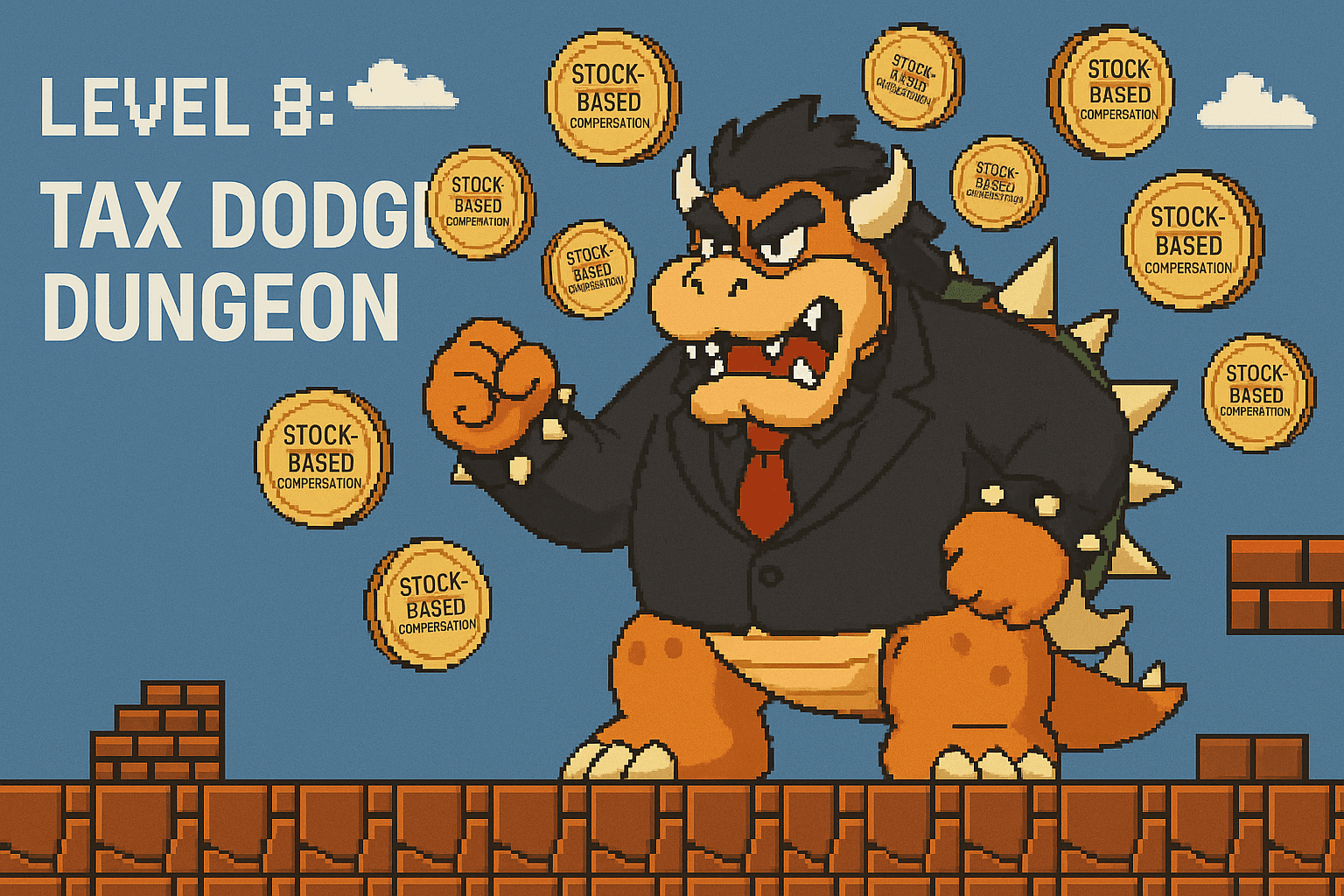
Discover how corporations use stock-based compensation to score massive tax deductions while boosting executive pay. In this satirical breakdown from The Write-Off Diaries, we expose the final boss of corporate tax strategies — where CEOs rake in millions and companies cry poor to the IRS. Learn how it works, why it’s legal, and how the tax code gets played by design.
recommended post

The Revolving Door Has a Billion-Dollar Handle

Tariffs - Take 3: The Branch that Wasnt There
Tariffs, Tantrums, and Who Actually Pays Part 2

Tariffs, Tantrums, and Who Actually Pays
The Write Off Diaries Part 10 - Loopholia Inc, The Beyoncé of Tax Planning
The Write Off Diaries Part 9 - Lobbying: How the Tax Policy Sausage is Made
The Write Off Diaries Bonus Post - You Could Be Doing This Too (But You Aren’t, and Here’s Why)
The Write Off Diaries Part 7 - Real Estate & 1031s - Sell Everything, Pay Nothing
Welcome to the final boss of corporate tax strategies. If you’ve made it this far, you know how the game works: it’s legal, it's lopsided, and it favors the entities with in-house counsel and a C-suite full of “performance incentives.”
Now we arrive at the crown jewel of non-cash tax tricks: stock-based compensation. This is the moment where a company can say, with a straight face:
“We just gave our CEO $120 million and somehow reduced our taxable income by even more. Isn’t capitalism efficient?”
Let’s walk through this magnificent piece of legal engineering — and why it’s the final boss in our tax avoidance series.
What Is Stock-Based Compensation?
Stock-based compensation is how companies pay people using equity instead of cash. This includes:
Stock Options (typically Non-Qualified Stock Options, or NSOs)
Restricted Stock Units (RSUs)
Performance Shares
Stock Appreciation Rights
Phantom Equity (a very real loophole with a very spooky name)
This approach lets companies:
Conserve cash
Boost retention
“Align incentives” (at least in theory)
And, importantly: turn non-cash payments into real, cash-equivalent tax deductions
The Mechanics: How the Loophole Works
Step 1: Grant the Stock
A company grants 10,000 stock options to an executive at a strike price of $10.
Step 2: Wait for Vesting and Price Growth
In Year 4, the stock is worth $70.
Step 3: The Executive Exercises the Options
They pay $100,000 (10,000 × $10) to buy stock now worth $700,000. Their taxable gain? $600,000.
Step 4: The Corporation Gets a Deduction
The company gets to deduct $600,000 as a compensation expense — even though it:
Didn’t spend $600K in cash
Didn’t give up an asset it previously held
Already recorded a much smaller expense for book purposes
Result:
Executive gets rich.
Company lowers taxable income.
Book income stays high (since the original expense was amortized and estimated at a much lower value).
GAAP vs. Tax: The Exploit Is in the Timing

It’s the ultimate arbitrage. You show strength to the markets and weakness to the IRS — in the same breath. And no one calls it cheating because it’s allowed.
Real Examples: Who’s Doing This?
Let’s name names:
Amazon
Frequently paid employees in RSUs instead of cash
In 2018: earned $11 billion in U.S. pre-tax income
Paid $0 in federal taxes
Why? Among other strategies: $1.1 billion in stock-based comp deductions
Pharma Giants
Heavily use stock options for senior researchers, execs, and board members
Large, one-time exercises often wipe out entire tax liabilities
Example: In 2017, Pfizer deducted $1.3 billion in stock-based comp
Tech Unicorns
Rely on equity to retain top talent without sacrificing cash flow
Run unprofitable on paper for years while stock value and tax losses balloon
Then flip the switch — profitable quarter, massive stock exercises, zero tax
The more successful the company, the bigger the tax deduction.
And the more volatile the stock, the better the timing works in your favor.
What Makes This Absurd?
Let’s review what actually happened:
No cash changed hands at the time of the deduction
The company didn’t lose anything in the traditional sense
They issued stock — which often increases in value because of their own hype
Yet the tax code says:
“Sure, treat it like a $600,000 salary payment. Deduct away.”
Even though:
It was a stock certificate
For shares they never purchased
That were valued years after they were granted
What About Book Income?
Under GAAP (Generally Accepted Accounting Principles):
Companies expense stock comp gradually, based on grant-date value
So if the shares were worth $15 each at grant, and they issue 10,000 shares, the total book expense is $150,000
Even if the market value later balloons to $70/share
This means:
Book income stays inflated (for investors)
Taxable income tanks (for the IRS)
The same compensation is reported at one value to Wall Street and another to the government
And It Gets Better (Worse)
This trick is even more powerful when companies buy back stock to offset dilution. That’s right:
The company issues shares to execs (tax deductible)
Then repurchases shares on the open market (non-deductible, but investors like it)
Result: The appearance of a disciplined, shareholder-friendly company — that just erased its tax bill
Some companies even finance buybacks with debt, creating a second tax deduction from interest.
How Do We Fix This?
Policy ideas on the table:
Cap corporate deductions at the book expense value (GAAP alignment)
Disallow deductions for non-cash compensation altogether
Apply minimum book income tax (which now exists, sort of — thanks to the Inflation Reduction Act)
Impose clawbacks for stock compensation deductions in cases of executive overpayment or restatements
Will any of these happen?
Possibly. But most corporations would rather fight tooth and nail to protect this — because no tax trick is more profitable, more accepted, or more cleverly hidden in plain sight.