Firm Insights & Updates
Tariffs, Tantrums, and Who Actually Pays Part 2
Dear reader, I hate being right like this.
recommended post

The Revolving Door Has a Billion-Dollar Handle
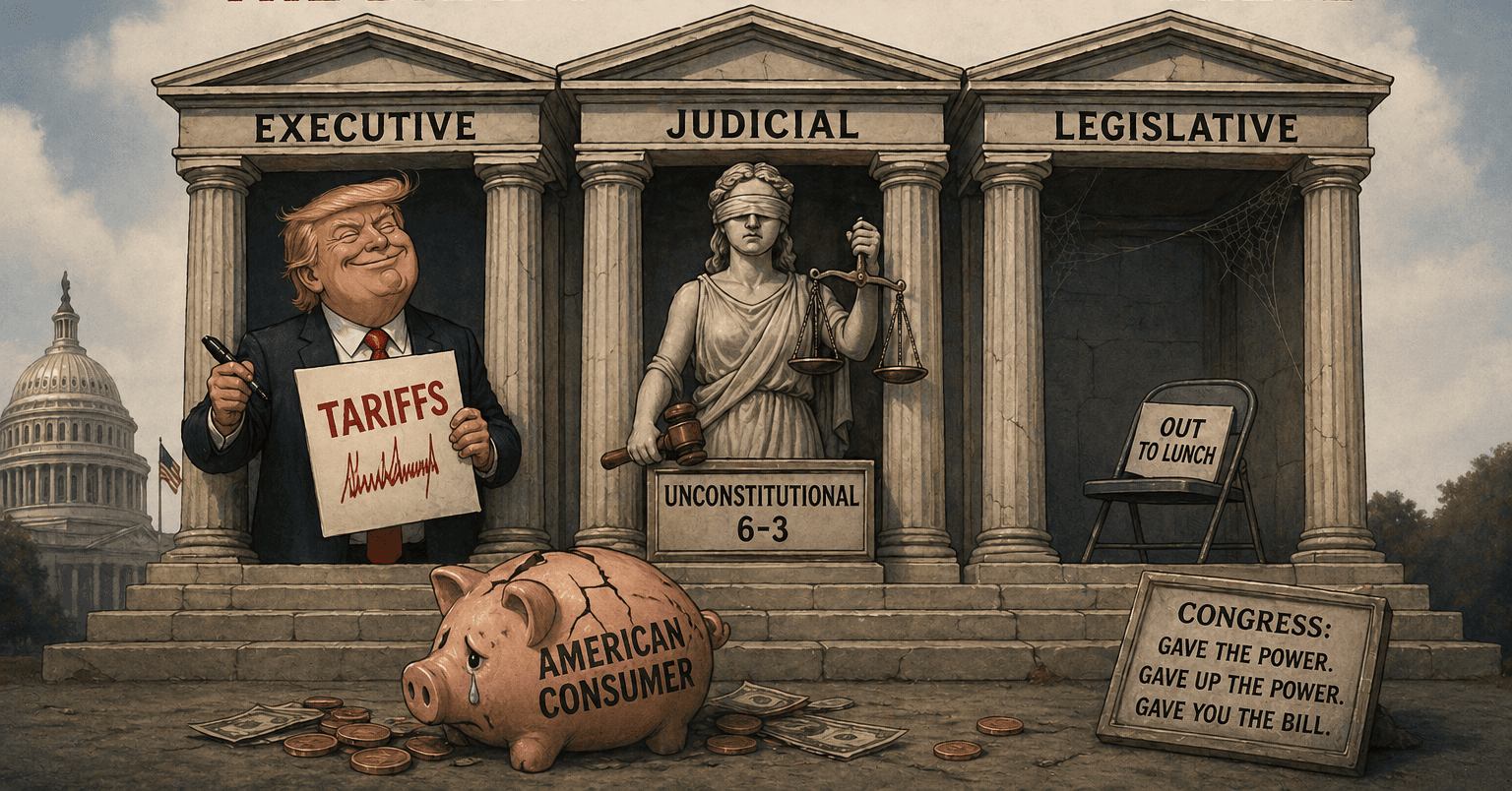
Tariffs - Take 3: The Branch that Wasnt There
Tariffs, Tantrums, and Who Actually Pays
The Write Off Diaries Part 10 - Loopholia Inc, The Beyoncé of Tax Planning
The Write Off Diaries Part 9 - Lobbying: How the Tax Policy Sausage is Made
The Write Off Diaries Part 8 - The Final Boss (For paying the Boss)
The Write Off Diaries Bonus Post - You Could Be Doing This Too (But You Aren’t, and Here’s Why)
The Write Off Diaries Part 7 - Real Estate & 1031s - Sell Everything, Pay Nothing
Six months ago I wrote a post about the Supreme Court oral arguments on Trump's IEEPA tariffs. In it, I said this:
"The only people getting a check are the ones who were already best positioned to absorb the cost in the first place. And the cruel punchline? Many of those same companies will have already passed on the cost to their buyers years ago — and will now pocket the refund anyway."
Well. About that.
The Supreme Court struck down the tariffs in February. Customs and Border Protection opened the refund portal last Monday. And the math is now in.
Dear reader, I hate being right like this.
What Actually Happened
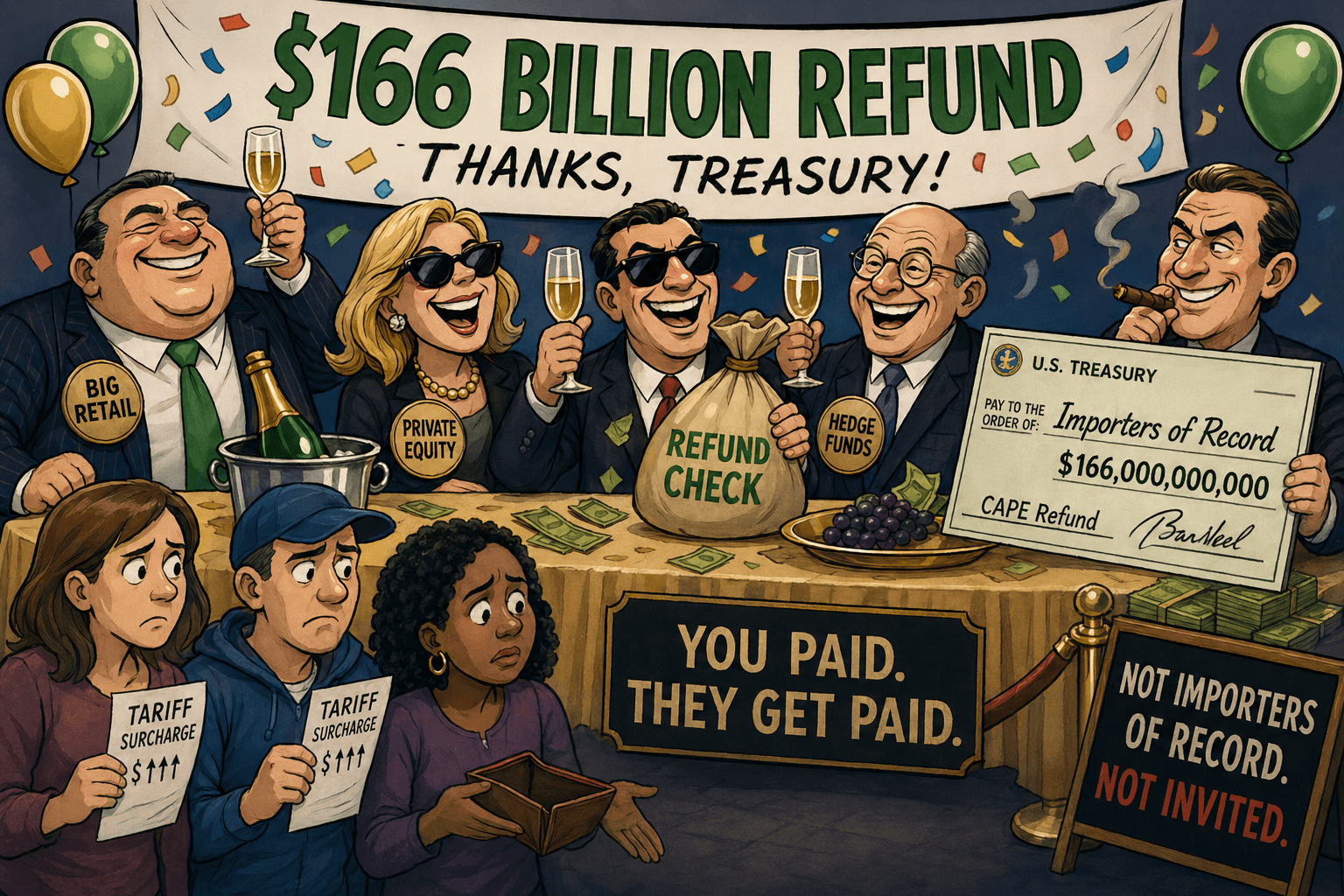
The total refund pool is $166 billion. That's the number of dollars that will flow out of the U.S. Treasury over the next eighteen months, back to the importers who paid the tariffs to Customs during 2025.
Not back to the American people.
Not back to the small manufacturers who bought at tariff-inflated prices.
Not back to your cousin who overpaid for a washing machine.
Back to the 330,000 Importers of Record — the only entities with standing to file a claim under the CAPE refund system that CBP just rolled out. Everyone else? Love that for you. Also, get bent.
The Part I Called in November
Let's do the receipts.
The Federal Reserve Bank of New York (February 2026): roughly 90% of the IEEPA tariff burden fell on U.S. firms and consumers. Foreign exporters absorbed about 10%.
The Kiel Institute for the World Economy (January 2026, 25 million shipment records): foreign exporters absorbed less than 4%. The rest — 96% — was passed through to U.S. buyers at the port.
Goldman Sachs (October 2025 update): on the full $166B, roughly 55% was paid by U.S. consumers at the register, 22% absorbed by U.S. businesses in margin, 18% by foreign exporters in reduced prices, and about 5% lost to tariff evasion. By end of 2026, consumer share is projected to hit 70%.
Translation for the non-wonks: of the $166 billion about to be refunded, roughly $91 billion was economically paid by American consumers.
Number of those consumers who can file a claim: zero.
Number of those dollars they will see: zero.
Number of politicians who will acknowledge this in their victory speeches: also zero.
The Double-Dip Nobody Wants to Talk About
Here's the part that makes a tax professional's eye twitch.
The Federal Reserve Bank of Boston's small-business survey found that the share of importers planning full tariff pass-through rose from about one-third to two-thirds as the tariffs dragged on through 2025. Many of them did it with an itemized "tariff surcharge" line on the customer invoice, which is the most honest way to do it — and also the most legally interesting.
So let's trace a single dollar:
2025: Importer pays $1.00 tariff to CBP on a widget
2025: Importer sells widget to wholesaler for cost + $1.00 "tariff surcharge"
2025: Wholesaler sells to retailer, price up accordingly
2025: Retailer sells to consumer, price up accordingly
2026: Supreme Court says tariffs were unconstitutional
2026: CBP refunds $1.00 to the importer
2026: Wholesaler, retailer, and consumer collectively: "Hey, what about—"
2026: Importer: "What about what?"
The importer now has two dollars. The one the customer paid, and the one Treasury refunded. For the same tariff. On the same widget. The arithmetic works out to this: some companies are literally being made whole twice.
This is not illegal. Nothing in the CAPE refund framework requires an importer who passed through the cost to refund their customers. Some will do it voluntarily (FedEx has said they'll try, bless their hearts). Most won't. It is not in any corporate finance playbook I've ever seen to refuse free money from the federal government on the grounds that your customers already reimbursed you for the thing you're now getting reimbursed for.
To be fair — and I mean this — some importers did absorb the tariff in margin. They were squeezed for a year and the refund is just getting them back to flat. Those are the operators I'm rooting for. They are, per the Fed data, a minority of the 330,000. The CAPE system has no mechanism to tell the difference. So the absorber and the double-dipper get identical checks. Efficient? Yes. Just? Ehhh.
And Now, the Vultures
Here's the part I didn't see coming in November, because apparently I have limits on my cynicism.
Starting in mid-2025, hedge funds and specialty finance firms started buying refund claim rights from importers at 20 to 30 cents on the dollar. Peacock Tariff Consulting has documented specific transactions: $8M electronics claim at 30%, $5M apparel claim at 25%, hedge fund consortia holding over $300 million in rights.
These claims were purchased before the Supreme Court ruled.
They are now worth up to 100 cents on the dollar.
That's a three-to-five-bagger in under six months. Citadel is sobbing quietly somewhere.
The trade was built on a public-domain legal analysis (IEEPA doesn't authorize tariffs, which law firms were arguing openly all year) but executed with a level of conviction and capital that implies something more than "we read a law review article." Senators Wyden and Warren have demanded documents from Cantor Fitzgerald regarding its reported interest in the trade. Congressman Jamie Raskin opened a House Judiciary investigation in February citing potential conflicts involving Commerce Secretary Howard Lutnick, whose sons now run Cantor. Cantor denies executing any transactions. The investigations are ongoing.
Without prejudging what the investigations find, the structural point stands: a $166 billion refund pool was visible to sophisticated capital six months before the court ruled. Those firms bought low and are now selling high, or collecting at par from the Treasury. The consumers who actually paid the tariffs could not have participated in that trade even if they had known about it — because, say it with me, they are not Importers of Record.
So Where Did the Money Actually Go?
Okay, pulling it together. Of the $166 billion about to flow out of Treasury, here's the rough institutional trace. Numbers are estimates — CBP doesn't publish beneficial ownership, because that would be useful — but they're triangulated from Census Bureau import data, PE industry analysis, and the claim-purchase reporting:
Public company shareholders (via the Walmarts, Targets, Costcos, Amazons, and their index-fund holders): 35–40%
Hedge funds and specialty finance firms that bought claims: 15–25%
Private equity limited partners (via PE-owned portfolio companies): 10–15%
Foreign corporate parents of U.S. subsidiaries: 8–12%
Actual privately-held U.S. business owners: 12–20%
Roughly three-quarters of the refund dollars are flowing to institutional capital. The remaining quarter goes to the privately-owned importer segment — which, yes, includes legitimate family businesses that got squeezed for a year. I want to be clear I am not anti-importer. I advise importers. Some of my best clients are importers. What I am is anti-the consumer who paid $91 billion of this tariff cost getting exactly nothing back while a hedge fund that figured out the legal angle first gets a 4x return.
The Victory Laps (Called These Too)
I told you in November what the political reactions would look like. Let's check the tape.
Left-leaning commentary this month has framed the refund as "justice for consumers" and "a defeat for Trump's economic agenda." The consumers, again, are receiving zero dollars. The defeat is a transfer of $166 billion from the federal Treasury to the exact corporate tier that cheered loudest when Congress passed IEEPA in the first place in 1977 (different administration, same structural winners).
Right-leaning commentary has framed the refund as "the restoration of property wrongfully seized by government." Which is fine as a principle but elides the question of whose property, since in 96% of cases it was the customer's property that got passed through to the importer in the first place. You can't restore property to someone who didn't lose it.
The correct political reaction would be: "Huh, we have structurally designed our customs refund law so that economic payers of invalid taxes cannot recover their money. That seems like something we should fix before the next one."
The number of politicians saying this: check back later, I'll update you if it happens.
What This Actually Means for You
If you are an importer who paid IEEPA tariffs, you should file a CAPE claim. That money is legally yours and genuinely yours if you absorbed the cost. If you passed the cost on, you still have the legal right to file, but you should think hard about whether your customer contracts, your industry's norms, or your conscience suggest you should share some of the refund back down the chain. I can help you think through this; I won't pretend to make the ethics decision for you.
If you are a downstream business that paid tariff-inflated prices from a U.S. supplier, you have no direct refund right, but you may have contractual leverage. Review your supplier agreements for tariff pass-through clauses. Some contain reversibility language. Most don't. Future negotiations are where you recover this one.
If you are a consumer who bought a washing machine, a can opener, a child's educational toy, an off-brand phone case, or almost anything imported in 2025 — you paid your share of this $166 billion, and you will not get any of it back, because the statute does not contemplate you. I am sorry. I know that is not helpful. Welcome to customs law. It is like tax law but somehow worse.
The Ironic Punchline, Part 2
Six months ago I wrote:
"A massive wealth transfer back to the very corporations who managed to monetize the tariffs on their way in and cash out on their way out. It's not consumer justice — it's corporate rebate season."
Consider this the updated version: it's not just corporate rebate season. It's corporate rebate season with hedge fund arbitrage on top, a congressional investigation on the side, and a side of double-recovery for anyone who itemized a tariff surcharge on their invoices. And the people who picked up the tab for the whole thing are, as always, not invited to the party.
Every time the government and corporations high-five in the name of the "American people," the American people are picking up the tab. I said it in November. I'm saying it again now.
And I'll probably be saying it again in six months, when some genius in Congress proposes the next "emergency" economic power, and nobody has bothered to fix the refund mechanism in the meantime.
See you then. Bring snacks.